
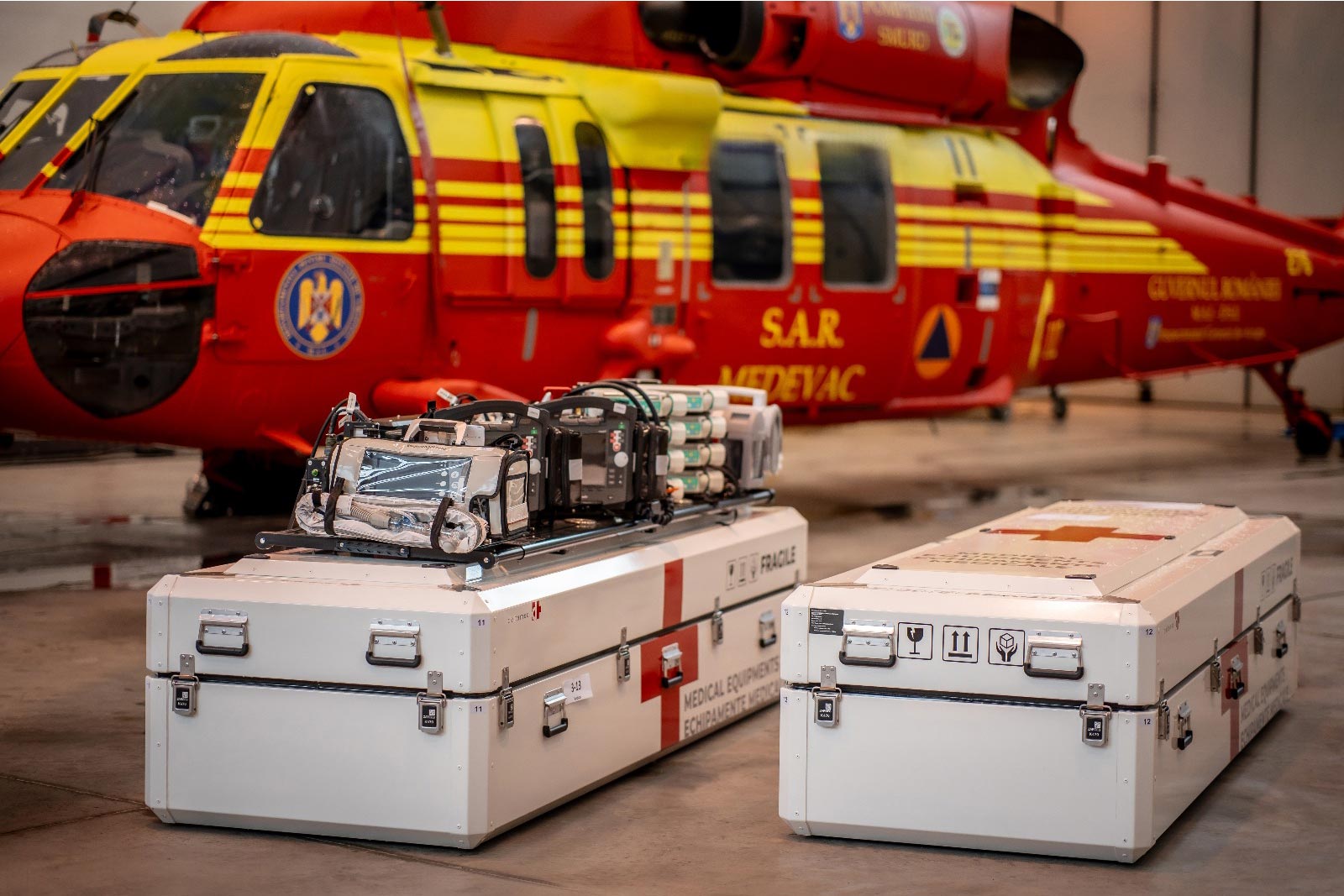
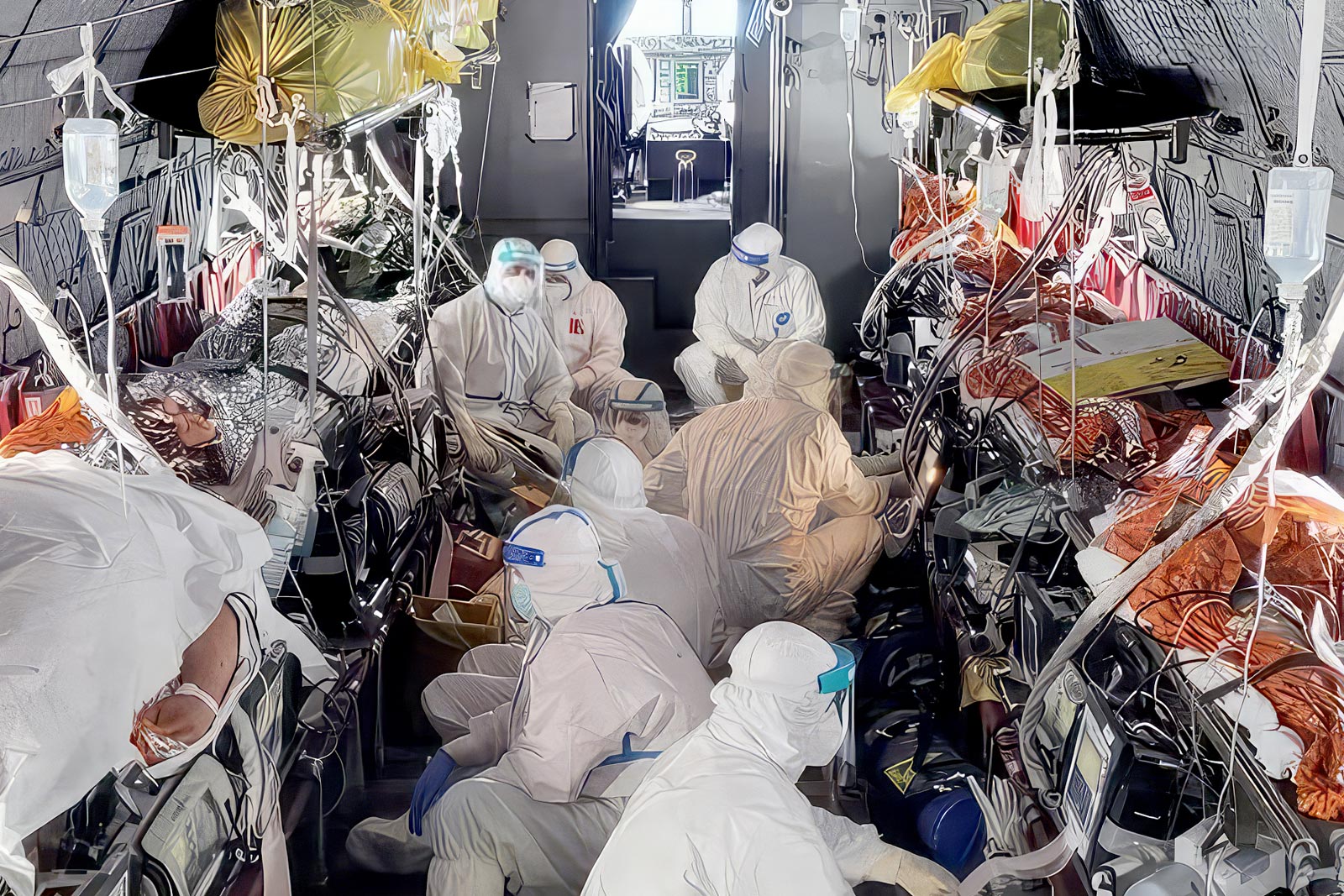
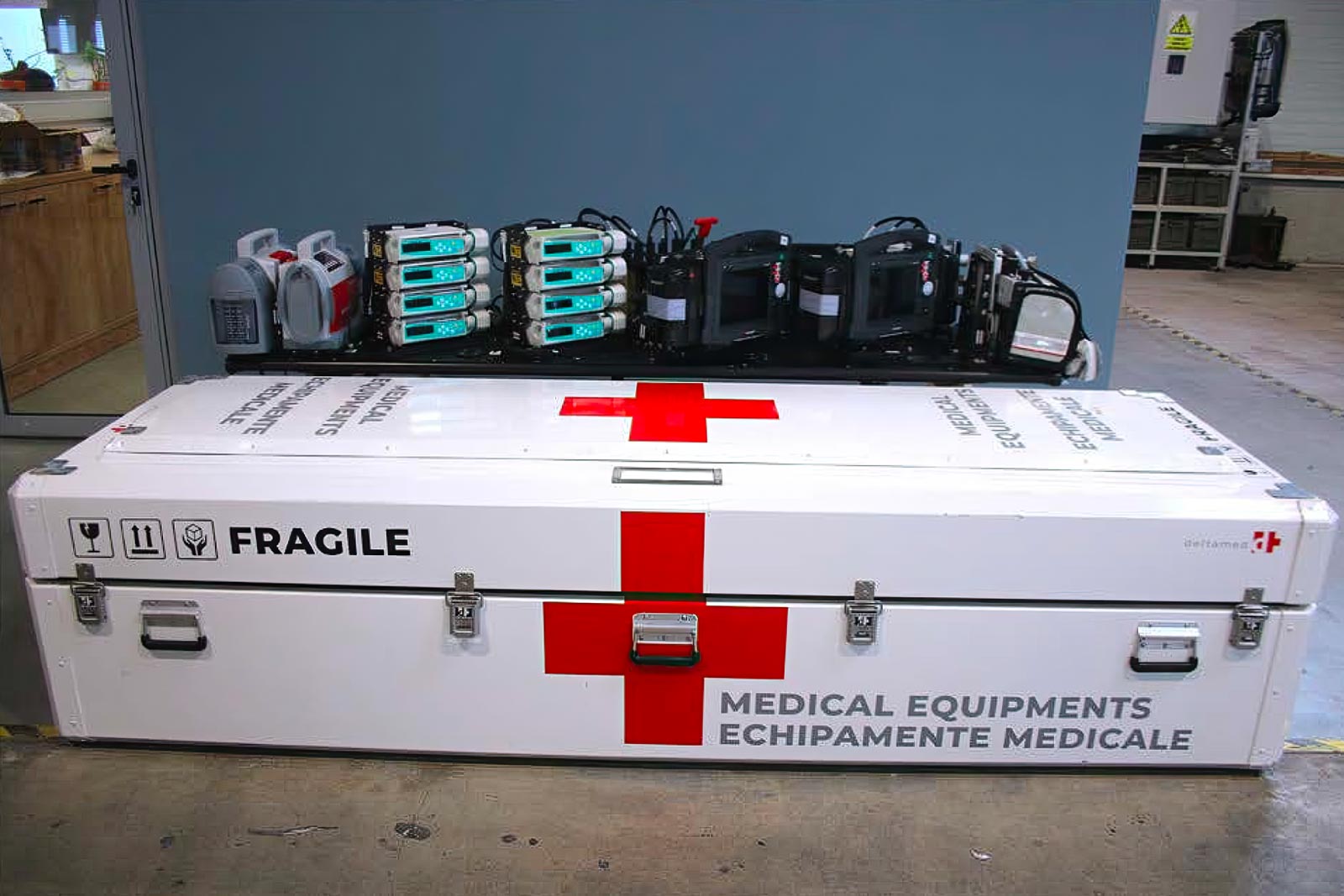
The medicalised stretcher provides monitoring and treatment at intensive-care level for one or two patients carried inside an aircraft on a system of stacked stretchers. Because the system is built on a NATO-type stretcher, any aircraft fitted with NATO stretcher fixations can be turned into a MEDEVAC aircraft. The stretcher is adapted to carry a modular patient monitor and defibrillator, a medical ventilator, two airway suction devices, two automatic syringe pumps and an oxygen storage and distribution system, with supports for further equipment available on request.
The equipment racks are identical to those Deltamed fits in land-based emergency services, so the patient — and the devices around them — transition seamlessly between aircraft and ambulance. Machine mounts change without tools, holder spacing is adjustable and interchangeable, screens are oriented vertically for readability, and the patient-monitor holder at the cephalic end rotates horizontally through 90–120°. Fully equipped, the entire assembly weighs under 100 kg.
The electrical system accepts 28 V DC aviation power or 110/230 V AC, converting internally to the 12–14 V DC used by portable medical devices, through a panel with MIL-standard fuses and a main switch; the wiring meets military aviation standards for smoke emission, flame retardancy, vibration, mechanical stress, oils and corrosive agents. Without external supply, the assembly runs for a minimum of three hours. On the ground, the stretcher docks into a purpose-built aluminium transport box — waterproof, air-conditioned to protect the equipment, with its own 110–230 V distribution panel for battery charging. Publicly deployed programmes include the Black Hawk S-70M and IAR-330 Puma helicopter fleets.
Photo gallery
Specifications
| Base | NATO-type stretcher, adapted for an integrated medical equipment system |
| Patient capacity | 1–2 patients per stretcher, intensive-care level; stretchers stackable in the aircraft |
| Aircraft compatibility | Any aircraft fitted with a NATO-type stretcher fixation system |
| Onboard equipment | Modular patient monitor and defibrillator, medical ventilator, 2 airway suction devices, 2 automatic syringe pumps, oxygen storage and distribution; further supports on request |
| Equipment mounts | Tool-less quick change; adjustable, interchangeable holder positions; monitor holder rotating 90–120° |
| Power | 28 V DC or 110/230 V AC; internal conversion to 12–14 V DC; MIL-standard fused panel with main switch |
| Wiring | Military aviation standards — smoke emission, flame retardancy, vibration, mechanical stress, oils, corrosive agents |
| Autonomy | Minimum 3 hours without external power supply |
| Weight | Under 100 kg with all medical equipment mounted |
| Transport box | Custom Deltamed design — aluminium, 250 × 85 × 58 cm, waterproof, air-conditioned, 10 carrying handles, 110–230 V distribution panel |