
How a Deltamed vehicle is built
One integrated process takes every Deltamed vehicle from digital model to signed test report, without a single stage leaving our control. This is what happens between your specification and your delivery.
One site, one continuous flow
Design office, fabrication halls, assembly lines and test laboratories operate in sequence, a few doors apart. A vehicle in production never leaves our control between stages — every component can be traced from raw material to handover, and the pace from one stage to the next is ours to control.
Design office
Mechanical and electrical engineering, simulation and technical documentation. Every vehicle is proven on screen before it exists in metal.
Fabrication halls
Dedicated halls for cutting, forming, coating and joining — the body and interior components other builders buy in are made here.
Assembly lines
Fabricated parts, wiring looms and medical or mission equipment come together here into one configured, serviceable vehicle.
Test laboratories
Verification has its own department, rooms and instruments — a vehicle is finished only when the test reports say so.
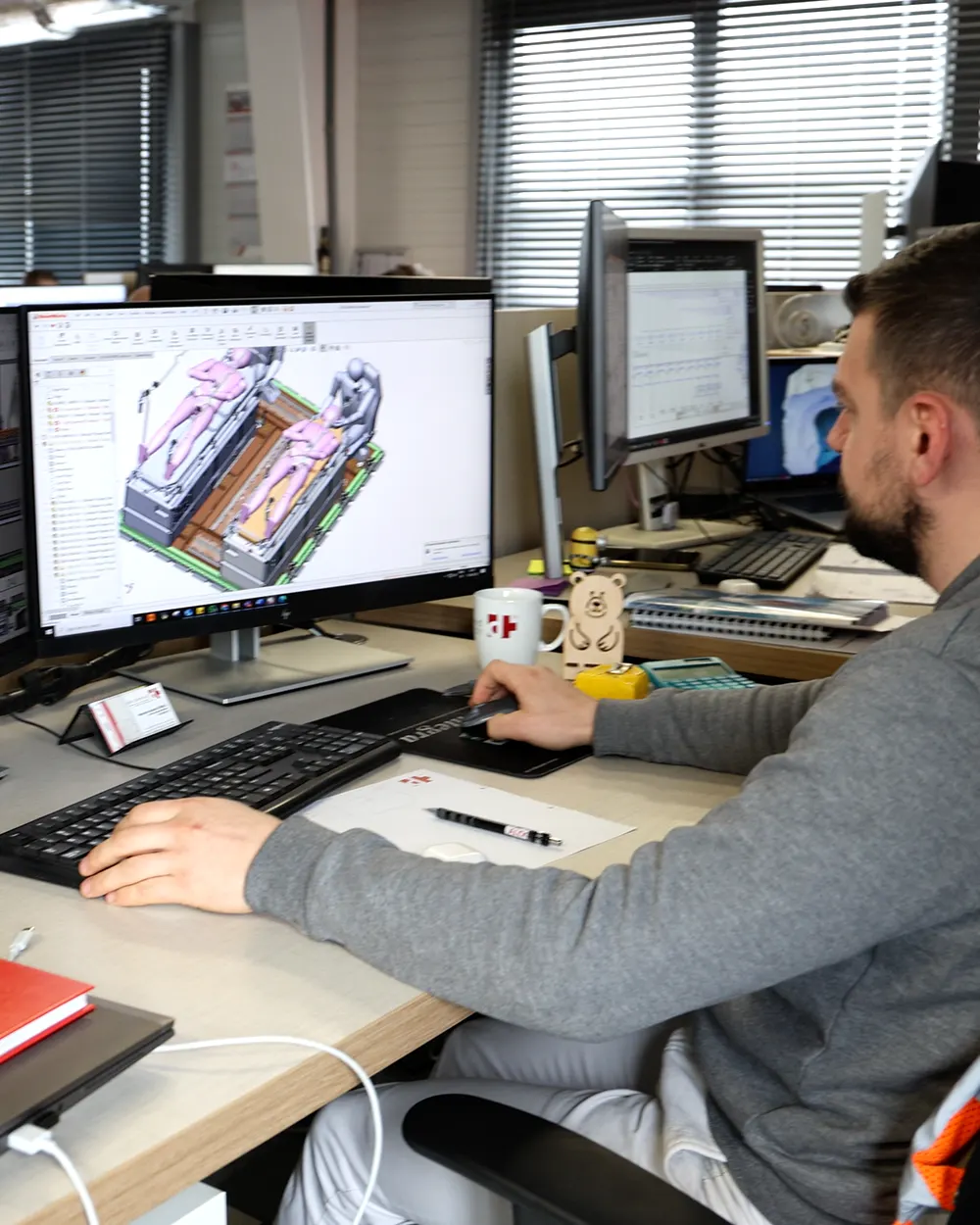
Engineering & simulation
Mechanical design
Each vehicle is developed in SolidWorks and validated through Ansys simulations: structural behavior, load cases and resistance are settled digitally, before fabrication begins. What reaches the workshop is a design that already works.
Electrical systems design
Power distribution, lighting, communications and medical-equipment circuits are designed around each vehicle’s mission profile, with safety and serviceability built in from the first schematic.
Fabrication in our workshops
Metal processing
CNC and high-precision laser cutting, bending and welding stations, professional sandblasting cabins and an industrial painting line — with quality checks between operations, not only after them.
ABS thermoforming
Interior and body components are formed at controlled temperatures on automated equipment, using molds designed and built in-house — which is what makes dimensional precision repeatable, vehicle after vehicle.
Technical carpentry & composites
Cabinetry and structural elements in wood and composite materials, produced on automated machinery, with finishes engineered for durability, ergonomics and integration with the vehicle’s systems.
Integration & customization
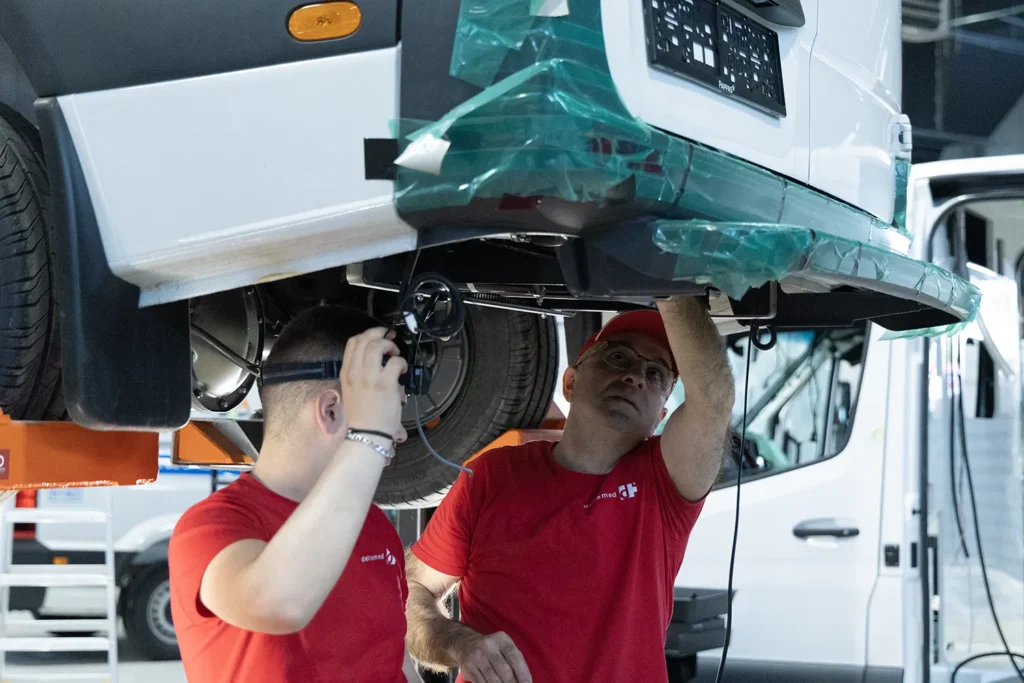
Final assembly
Specialized teams bring every fabricated component together — mechanical structures, electrical systems, medical and mission equipment — into one coherent vehicle that can be serviced as easily as it was assembled.
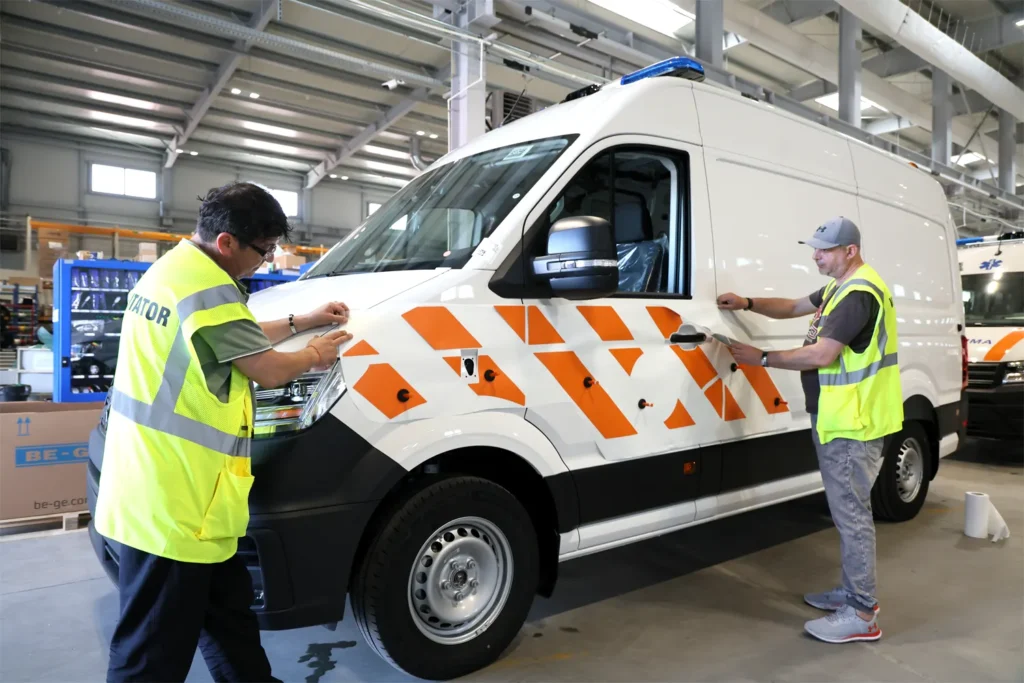
Wrapping & identity
Each vehicle receives its mission-specific graphics in high-visibility, durable materials, applied with modern marking techniques — identifiable in any conditions, and still identifiable years into service.
Testing & quality control
Quality at Deltamed is not an inspection at the end of the line — it is a planned, statistically controlled process (Control Plan, SPC, PFMEA) applied throughout production. Before delivery, every vehicle and its equipment face conditions harder than daily service.
Mechanical & durability testing
Vibration rigs reproduce the mechanical cycles of years of operation, verifying the endurance of seats, stretchers and patient-transport systems under real transport loads.
Environmental testing
A climatic chamber takes each vehicle through temperature extremes, and our water-tightness chamber subjects it to the equivalent of 125 liters of rain per square meter — leaks are found here, not in the field.
Non-destructive testing (NDT)
Visual and endoscopic inspection, penetrant testing, acoustic testing, airflow and light-tightness verification — flaws are detected without ever compromising the component.
Electrical & medical equipment testing
Electrical safety analyzers, gas analyzers and patient simulators confirm that every electrical and electro-medical system performs exactly as certified.
Built with control. Delivered with confidence.
From the first simulation to the final test report, nothing is delegated and nothing is assumed. That is how a Deltamed vehicle earns its place in your fleet.